Executive Summary
The Doppelgänger (aka Social Design Agency (SDA)) campaigns are a coordinated series of online influence operations attributed to Russian-linked actors and associated with the technical operator, Structura. The campaign leverages a distributed ecosystem of spoofed media websites, Telegram amplification networks, and coordinated X/Twitter bot account clusters to disseminate political narratives targeting Western audiences.
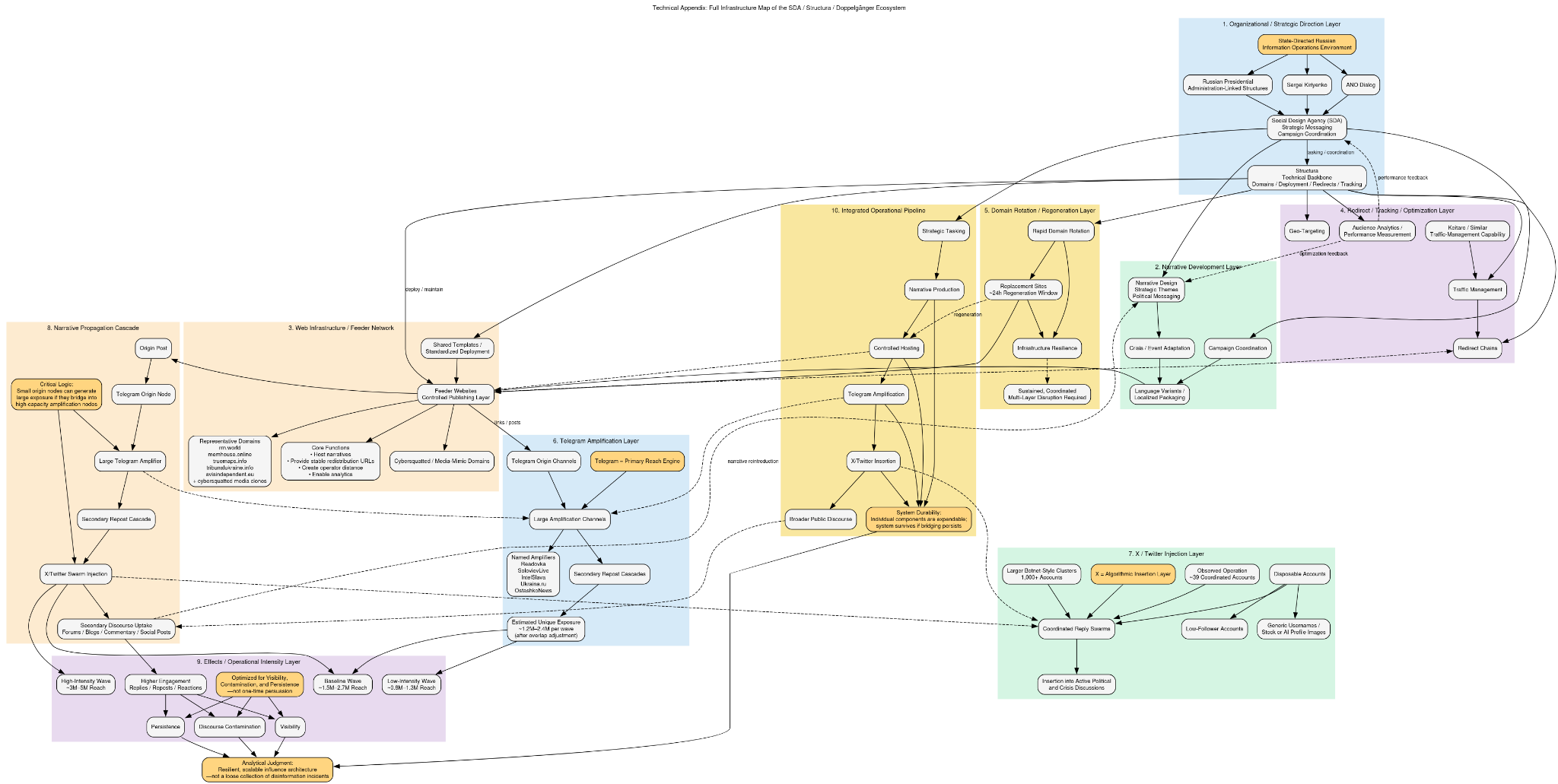
The operational architecture is designed around a feeder-and-amplifier model. Controlled websites host narrative artifacts such as articles, memes, and commentary. These artifacts are distributed through Telegram channels with large subscriber bases and are subsequently injected into active discussions on X through coordinated reply swarms.
This architecture enables the campaign to scale rapidly while maintaining resilience against disruption. Domain infrastructure can be regenerated quickly, social accounts are disposable, and narratives can be redistributed through independent amplification channels.
Analysis of subscriber counts and documented campaign activity suggests that a typical Doppelgänger narrative wave exposes approximately 1.5 to 2.7 million users, with larger event-driven campaigns potentially reaching 3 to 5 million users.
The campaign’s objective is not necessarily direct persuasion but narrative saturation, in which repeated exposure across multiple platforms introduces and normalizes targeted narratives within the information ecosystem.
Actor and Organizational Structure
The operational structure of the Doppelgänger influence campaign reflects a coordinated system that combines strategic messaging organizations, technical infrastructure providers, and elements associated with Russia’s broader state-directed political communication environment. At the center of this ecosystem are two entities that appear to play complementary roles: the Social Design Agency (SDA) and Structura. Together, these organizations form the operational core of the campaign’s architecture, linking narrative development with the technical systems required to publish, distribute, and amplify influence content across multiple digital platforms.
The Social Design Agency (SDA) appears to function as the primary strategic and operational planning body behind the campaign. Open-source investigations and public reporting have associated the organization with a number of large-scale information operations targeting audiences in Europe and North America. Within the Doppelgänger ecosystem, SDA’s role is assessed to focus on the design and coordination of narrative components that underpin the campaign’s messaging. This includes the development of thematic narratives, the planning and timing of coordinated influence activities, and the orchestration of distribution through social
media channels and affiliated amplification networks. SDA also appears to maintain relationships with technical service providers responsible for maintaining the infrastructure used to host and disseminate campaign content. In this capacity, the organization functions as the central coordinating entity that aligns narrative development, operational timing, and distribution strategies across the broader influence network.
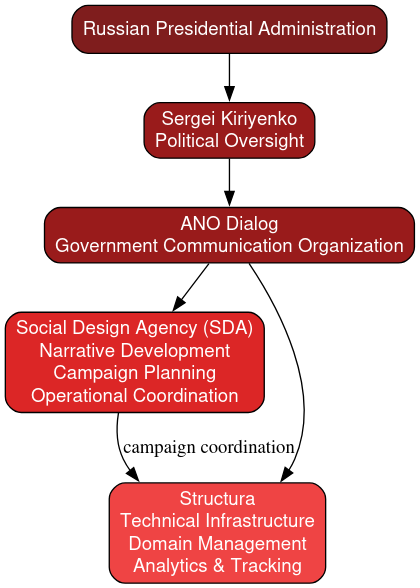
Complementing this strategic function, Structura appears to provide the technical infrastructure that allows the campaign to operate at scale. Structura acts as the backbone of the Doppelgänger ecosystem by managing the digital assets used to publish, distribute, and track campaign narratives. Its responsibilities include the registration and administration of domains used for pseudo-media websites, the deployment and maintenance of the web infrastructure hosting campaign articles, and the operation of redirect systems that guide audiences from social media platforms to campaign-controlled sites. Structura is also believed to operate analytics and tracking capabilities that enable operators to measure engagement levels, monitor traffic patterns, and evaluate the performance of individual narratives. These capabilities support both operational resilience and adaptive campaign management, allowing infrastructure to be regenerated or replaced quickly when domains are seized, blocked, or otherwise disrupted.
Evidence from multiple public investigations further suggests that the Doppelgänger campaign operates within a broader ecosystem of Russian state-aligned information activities. Reporting has connected elements of the network to organizations and political communication structures associated with the Russian Presidential Administration, including the government-linked organization ANO Dialog and senior political figures such as Sergei Kiriyenko, who has been identified in public reporting as playing a significant role in coordinating domestic and international messaging initiatives. While the precise command relationships within this ecosystem are not fully transparent, these connections indicate that the operation likely functions within a wider strategic communications environment linked to Russian state interests.
Taken together, the interaction between SDA’s narrative planning and campaign coordination functions, Structura’s management of technical infrastructure, and the broader involvement of state-linked political communication structures suggests a coordinated operational model. Within this model, influence operations are integrated into a larger system of information confrontation. Inside the system, messaging strategy, technical infrastructure, and distribution networks are aligned to introduce and amplify narratives within the international information environment in ways that support broader geopolitical objectives.
Synthetic Media Personnel Structure (RRN Employee Layer)
Analysis of the ingested employee directory from Reliable Recent News provides direct insight into the constructed human layer underpinning the Doppelgänger ecosystem. In contrast to infrastructure or domain-based analysis, this dataset reveals how the operation systematically simulates a functioning media organization through a curated set of personnel, roles, and hierarchical relationships. This structure does not reflect a genuine workforce; rather, it constitutes a deliberately engineered organizational façade designed to support narrative attribution and reinforce perceived credibility.
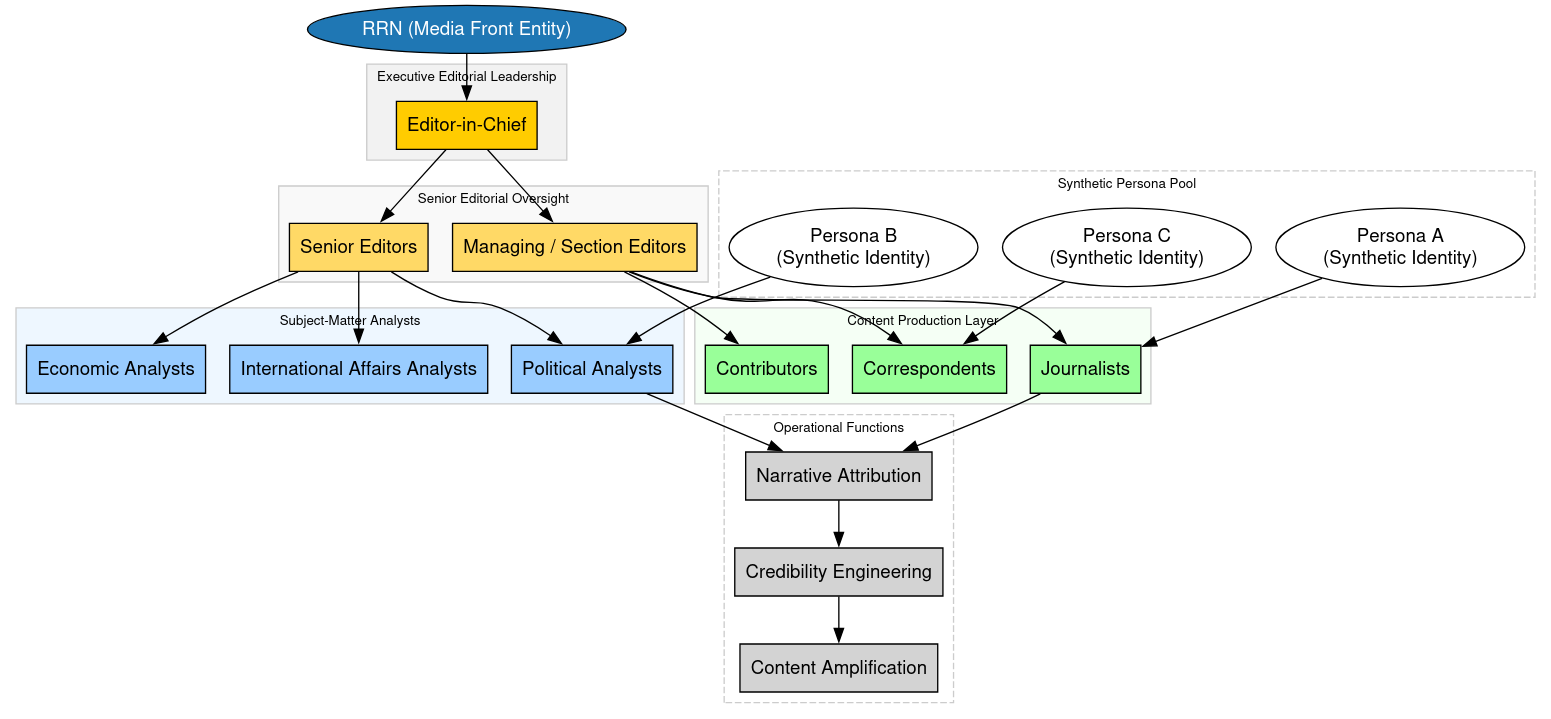
The employee listing presents a fully developed newsroom hierarchy that closely mirrors legitimate Western media institutions, with an Editor-in-Chief at the apex, followed by senior and section editors, subject-matter analysts, and a base layer of journalists, correspondents, and contributors. The consistency and repeatability of this structure indicate a templated design rather than organic organizational growth, replicating the visual and procedural signals of editorial rigor, review, and domain expertise associated with credible outlets. In practice, these roles function primarily as perception management mechanisms: senior editors act as legitimacy anchors, analysts serve as authority proxies for geopolitical narratives, and journalists provide bylines that convert anonymous content into ostensibly reported material. Collectively, this framework simulates the full lifecycle of journalism analysis, reporting, editing, and publication without any underlying authentic process.
The identities themselves exhibit hallmarks of synthetic construction, including generic Western naming conventions, absence of external validation, and minimal or templated biographical detail, supporting their assessment as fabricated and designed for reuse. The uniform role structure enables rapid replication across domains, reinforcing consistent credibility signals while allowing personas to be reassigned or recycled without disrupting the façade of institutional integrity. Functionally, this layer operates as an intermediary between content and audience perception, transforming unattributed messaging into authored analysis extended across websites, Telegram channels, and social platforms to create a persistent identity presence. This demonstrates that the Doppelgänger operation incorporates identity fabrication as a core architectural component that is structured, reusable, and integral to delivery. It also means that effective disruption must address not only infrastructure but this portable persona layer, which can be rapidly redeployed to reconstitute credible media fronts.
Infrastructure Architecture
Feeder Website Network
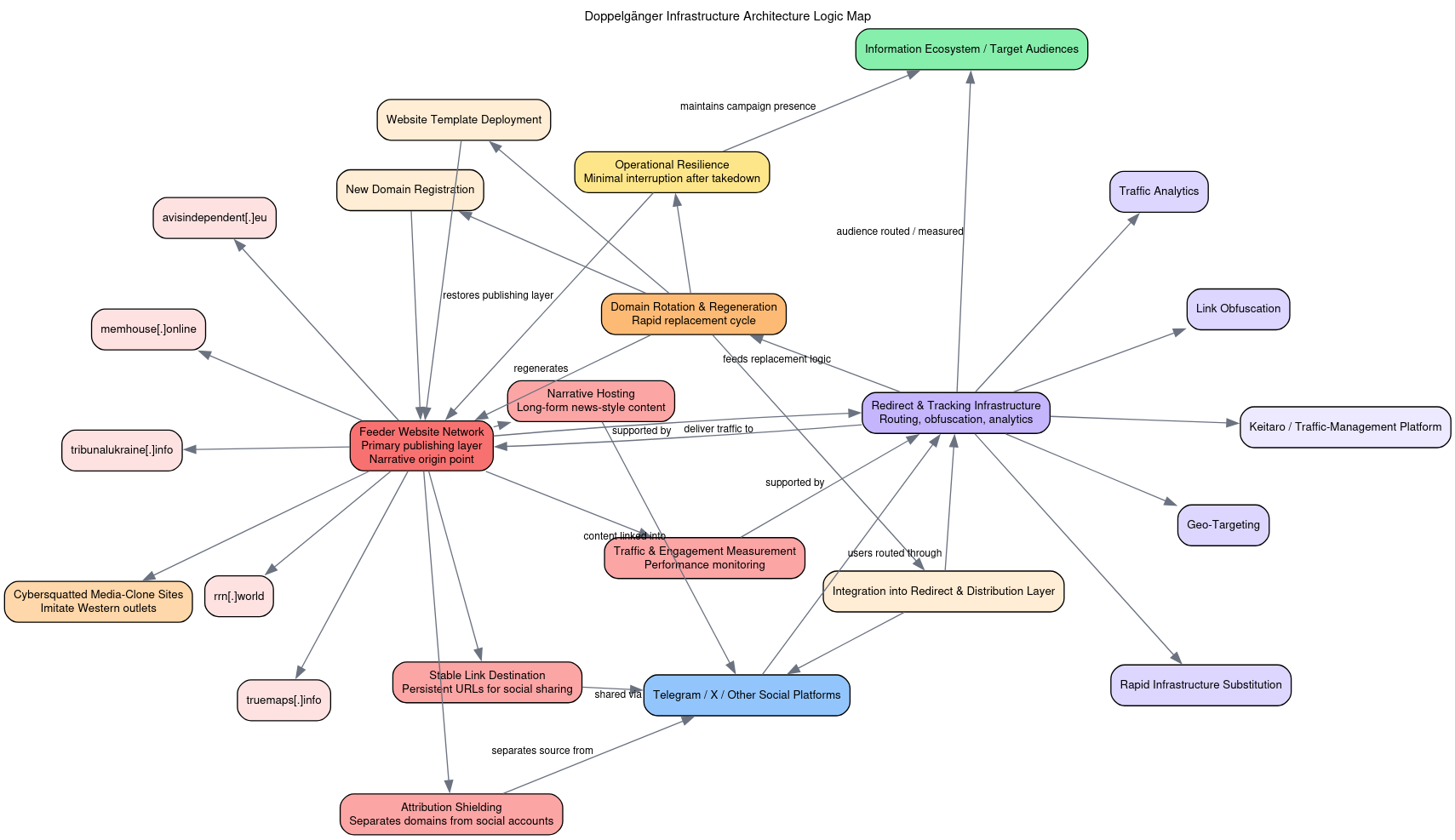
The operational foundation of the Doppelgänger campaign is a distributed network of websites designed to host narrative content while closely mimicking legitimate news organizations. These sites function as the primary publishing layer of the campaign, providing the initial point of origin for narratives that are subsequently distributed across social media platforms.
Rather than relying exclusively on social media posts, the campaign infrastructure directs audiences to these external domains, which are designed to resemble independent media outlets. This approach provides several operational advantages. First, it allows operators to publish long-form narrative content that appears to originate from a news-style source rather than from social media accounts. Second, it creates a stable destination for links shared across Telegram channels and X/Twitter accounts, enabling narratives to persist even when individual social media posts are removed or accounts are suspended.

The feeder sites also serve an important operational security function. By hosting narrative content on controlled domains, operators create a layer of separation between the messaging infrastructure and the social media accounts used to distribute the content. This separation complicates attribution and allows narratives to circulate through secondary citation chains in which the original campaign infrastructure is no longer visible.
In addition to narrative hosting and attribution shielding, the feeder websites allow operators to collect traffic metrics and engagement data. By directing audiences to controlled domains, campaign operators can measure which narratives attract the greatest engagement and adjust future messaging accordingly.
Investigations into the Doppelgänger infrastructure have identified several representative domains associated with the campaign’s publishing network, including rrn[.]world *now an investigative site into SDA not an SDA controlled domain*, memhouse[.]online, truemaps[.]info, tribunalukraine[.]info, and avisindependent[.]eu. Alongside these domains, the ecosystem includes numerous cybersquatted sites designed to resemble well-known Western news organizations. These domains typically replicate visual branding, layout, and naming conventions of legitimate media outlets in order to increase the perceived credibility of the hosted content.
Redirect and Tracking Infrastructure
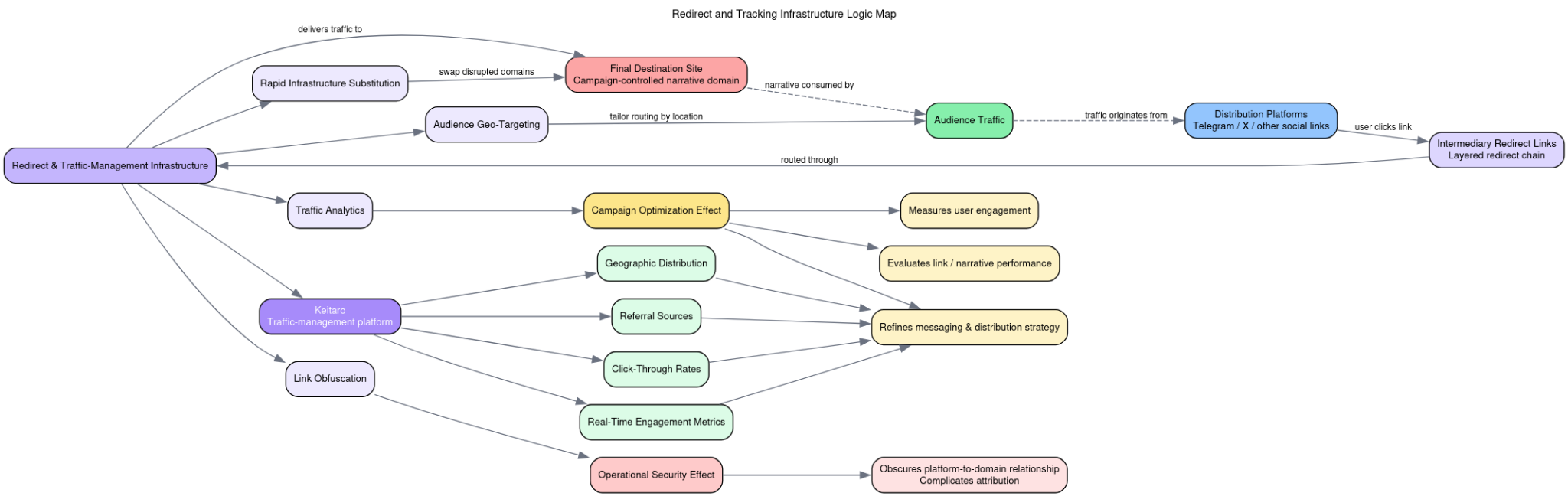
Supporting the feeder website network is a layered redirect and traffic-management system that enables the campaign to control how audiences reach narrative content. This infrastructure provides several operational capabilities, including audience geo-targeting, detailed traffic analytics, link obfuscation, and rapid substitution of infrastructure when individual domains are disrupted.
Redirect chains allow campaign operators to route users through multiple intermediary links before they arrive at the final destination site. This technique serves both operational security and campaign optimization purposes. From an operational perspective, it obscures the relationship between the original distribution platform and the hosting domain, making attribution more difficult. From an analytics perspective, it allows operators to monitor user engagement and measure the performance of individual links and narratives.
Public investigations have identified the use of traffic-management platforms such as Keitaro, a software system widely used in affiliate marketing ecosystems to manage link routing and analyze traffic patterns. When applied within influence operations, tools of this type can provide operators with detailed information about audience behavior, including geographic distribution, referral sources, and click-through rates. These capabilities enable campaign managers to refine messaging and distribution strategies based on real-time engagement metrics.
Domain Rotation and Regeneration

A defining characteristic of the Doppelgänger infrastructure is its ability to regenerate quickly when individual domains are blocked or seized. The campaign employs a strategy of continuous domain rotation in which new websites are deployed to replace disrupted infrastructure with minimal delay.
Evidence from multiple investigations indicates that replacement domains can appear with rapidity after a disruption event. This rapid regeneration capability suggests the presence of an organized infrastructure management process capable of registering domains, deploying website templates, and integrating new sites into the existing redirect and distribution systems on short notice.
The ability to rapidly replace infrastructure significantly increases the resilience of the campaign. Even when individual domains are removed by platform enforcement actions or law enforcement interventions, the broader narrative distribution network can continue operating with minimal interruption. As a result, the campaign’s influence activities persist through a cycle of disruption and regeneration that allows operators to maintain a continuous presence within the information ecosystem.
Operational Distribution Model
The Doppelgänger campaign distributes narratives through a structured, multi-stage pipeline designed to move content from controlled publishing infrastructure into large-scale public exposure across social media platforms. Rather than relying on a single channel for dissemination, the campaign employs a layered distribution architecture in which each stage performs a distinct operational role. This structure allows operators to maintain separation between narrative creation, infrastructure hosting, and public amplification, increasing both the resilience and scalability of the campaign.
The process begins with content creation, where narratives are developed and formatted for publication. At this stage, messaging themes are crafted to align with broader campaign objectives and current geopolitical developments. The narratives are typically designed to resemble journalistic reporting or analysis in order to increase their credibility and shareability once introduced into public discourse.
Once created, the content is published on feeder websites controlled by the campaign infrastructure. These sites serve as the primary hosting layer for narrative material and provide a stable destination for links that will later be shared across social media platforms. By placing the content on standalone domains that mimic legitimate news outlets, operators create a degree of separation between the narrative source and the social accounts used for distribution.

Following publication, the narrative enters the Telegram amplification stage. Telegram channels with established audiences serve as the primary distribution engine for the campaign. These channels repost links to the feeder websites, exposing the narratives to large subscriber bases and creating the initial wave of engagement. Because many of these channels already maintain audiences interested in geopolitical or ideological content, Telegram functions as an efficient mechanism for rapidly spreading narratives to receptive communities.
After gaining traction within Telegram networks, the campaign proceeds to X/Twitter injection. At this stage, coordinated social media accounts begin posting links to the feeder sites or discussing the narratives within existing conversations on the platform. These posts often appear within replies to trending topics, political discussions, or posts from influential accounts. The goal of this stage is to introduce the narrative into broader public discourse, reaching users who are not directly connected to the Telegram amplification network.
The final stage of the pipeline is audience exposure, where the narrative reaches individuals across the wider information ecosystem. At this point, the content may be encountered through social media threads reposted by other users, or referenced in discussions across forums, blogs, and other digital platforms. Once a narrative reaches this stage, it may continue circulating independently of the original campaign infrastructure.
This multi-stage distribution model allows the Doppelgänger campaign to move narratives from controlled infrastructure into mainstream online discourse while maintaining operational flexibility. By separating narrative creation, hosting, and amplification across distinct layers, the campaign achieves both scalability and resilience, enabling it to sustain influence activities even when individual domains or accounts are disrupted.
Telegram Amplification Layer
Within the Doppelgänger campaign architecture, Telegram functions as the primary distribution engine and reach multiplier. While feeder websites host the narrative content and X/Twitter accounts inject the narratives into public conversation, Telegram channels provide the high-capacity amplification required to expose those narratives to large audiences quickly.
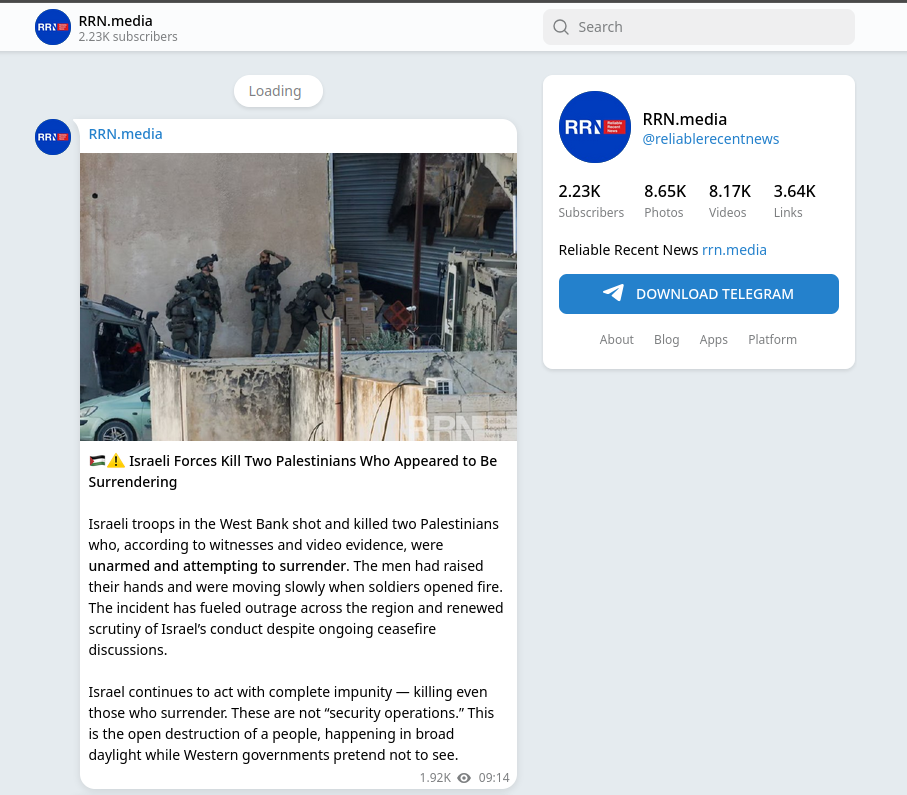
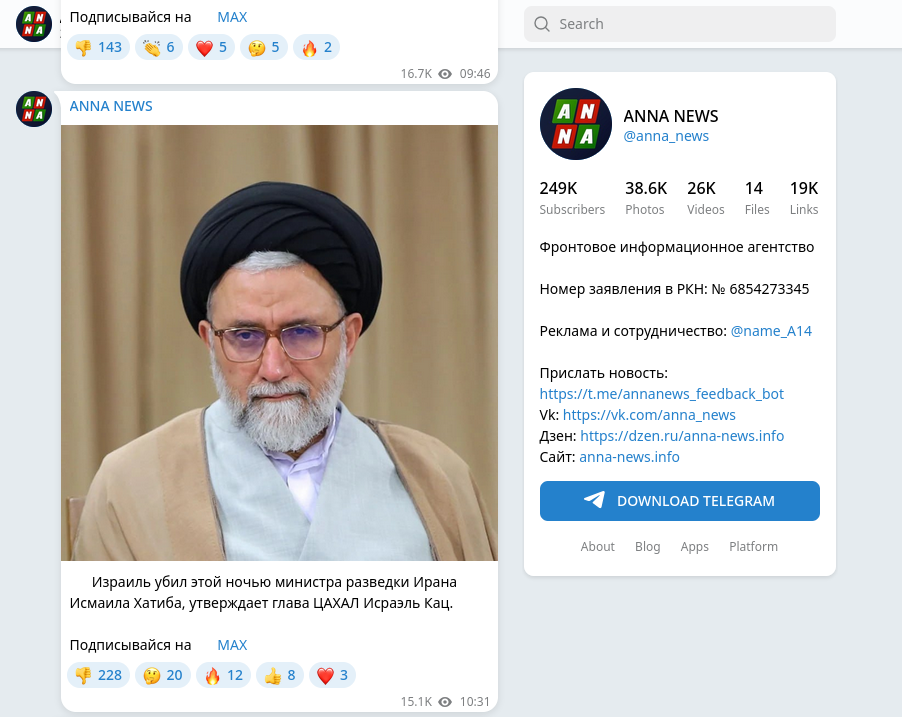
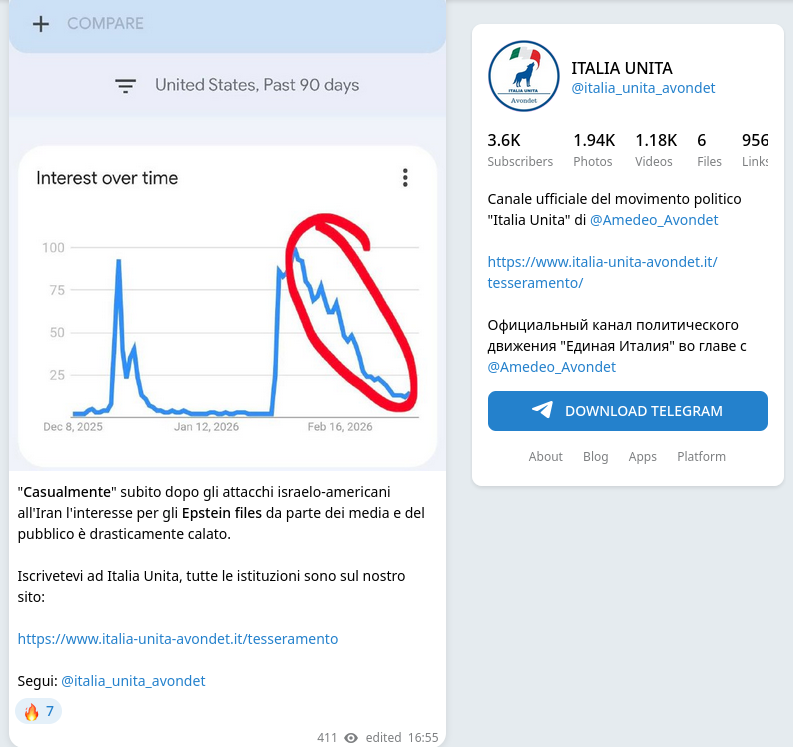
The platform’s structure makes it particularly well suited to this role. Telegram channels can accumulate very large subscriber bases and distribute content instantly to those audiences without the algorithmic filtering mechanisms present on many Western social media platforms. As a result, a single post in a high-subscriber channel can expose campaign narratives to hundreds of thousands of users within minutes.
The Doppelgänger campaign leverages this dynamic by utilizing established channels within the broader pro-Kremlin Telegram ecosystem. These channels function as distribution hubs, reposting links to feeder websites and circulating campaign narratives across interconnected networks of subscribers. Once a narrative appears in one of these large channels, it is frequently reposted by smaller affiliated channels, creating an amplification cascade that expands the narrative’s reach across the platform.

Several prominent Telegram channels have been identified as major amplifiers within this ecosystem. These include Readovka, SolovievLive, IntelSlava, Ukraina[.]ru, and OstashkoNews, each of which maintains a substantial subscriber base and regularly circulates geopolitical and war-related content aligned with pro-Kremlin messaging. Collectively, these channels represent a significant distribution network capable of reaching millions of users.
Combined subscriber counts across these channels exceed five million accounts. However, subscriber overlap between channels means that the total audience exposed to a given narrative is smaller than the raw subscriber numbers might suggest. Many users subscribe to multiple channels within the same information ecosystem, which reduces the number of unique individuals reached by each amplification wave.
Taking this overlap into account, the estimated unique exposure per narrative wave distributed through these major channels historically has approximately been up to 1.2 to 2.4 million viewers. This range reflects the realistic audience size likely to encounter a narrative during a typical amplification cycle.
Because of this reach, Telegram serves as the central amplification layer within the Doppelgänger campaign. The platform enables rapid dissemination of narratives from the feeder website network and provides the initial audience engagement that supports subsequent injection of those narratives into broader social media conversations on platforms such as X/Twitter.
X / Twitter Injection Layer
Within the Doppelgänger campaign architecture, X (formerly Twitter) serves a different operational function from Telegram. Whereas Telegram channels provide large-scale distribution to existing subscriber audiences, X is primarily used as a mechanism for narrative insertion into active public conversations. The platform’s role in the campaign is therefore less about direct reach through large follower bases and more about leveraging algorithmic visibility within ongoing discussions.
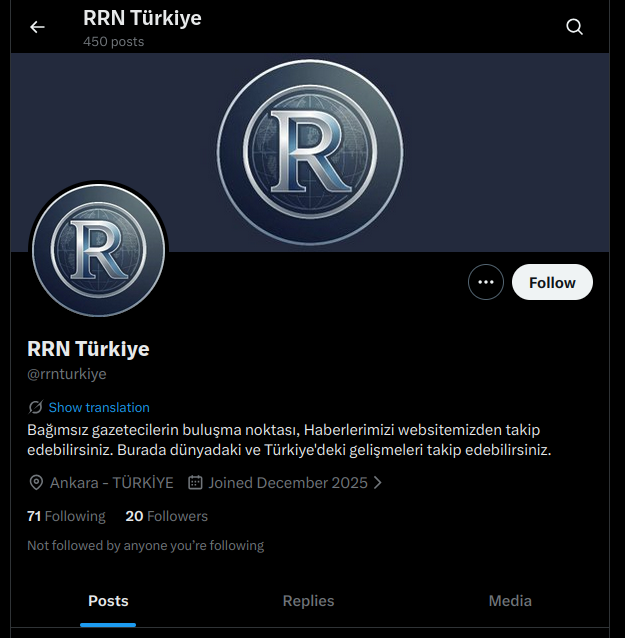
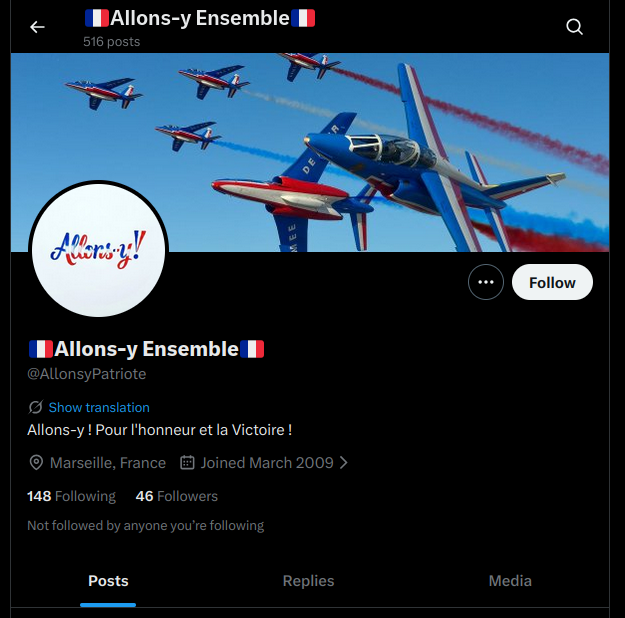
Unlike traditional influence campaigns that rely on prominent influencers or high-follower accounts, Doppelgänger operators typically deploy clusters of disposable social media profiles. These accounts are designed to be rapidly created, used for short operational periods, and replaced when suspended or detected. As a result, the accounts associated with these operations often exhibit several common characteristics.
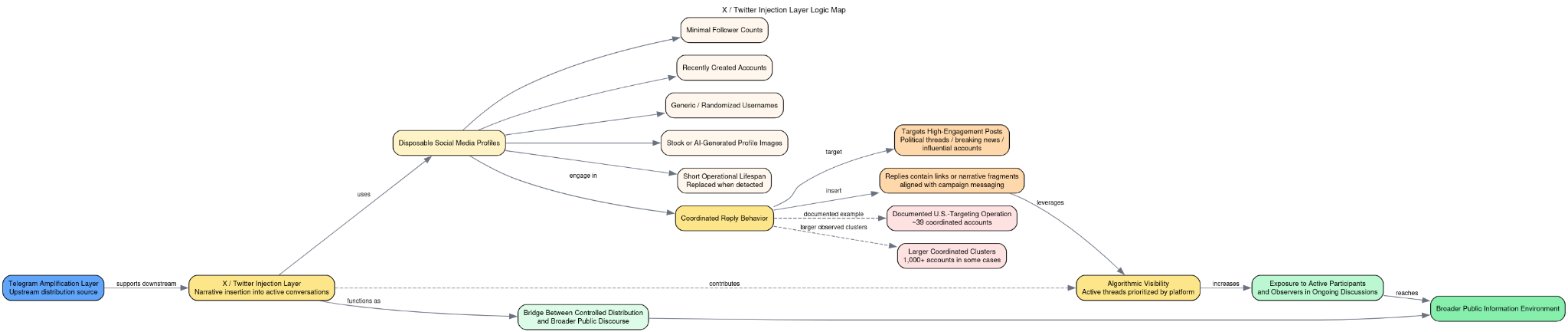
Most have minimal follower counts, indicating that they are not intended to build long-term audiences. Many profiles are recently created, sometimes within days or weeks of their participation in coordinated posting activity. Usernames frequently consist of generic or randomly generated combinations of characters, and profile images are commonly drawn from stock photography or produced using AI-generated portrait tools. These traits collectively suggest that the accounts are designed primarily for operational utility rather than credibility or sustained engagement.
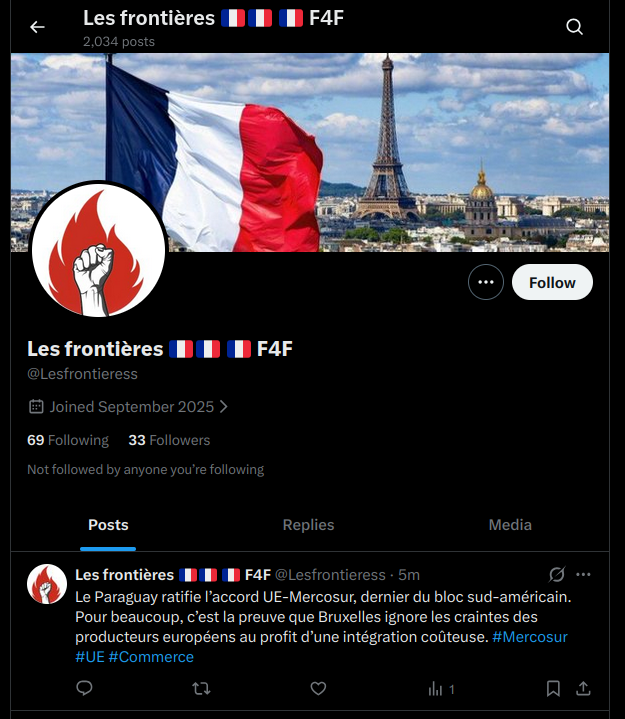
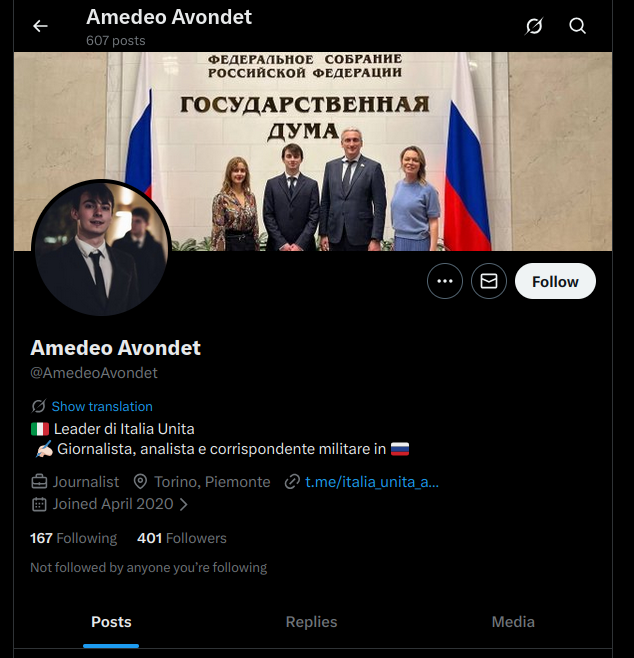
Instead of broadcasting content to followers, these accounts engage in coordinated reply behavior. Operators target posts that are already receiving significant engagement—such as political discussions, breaking news events, or posts from high-profile accounts—and insert replies containing links to feeder websites or narrative fragments aligned with campaign messaging. By appearing within existing conversation threads, the campaign attempts to expose the narrative to users who are already participating in or observing those discussions.
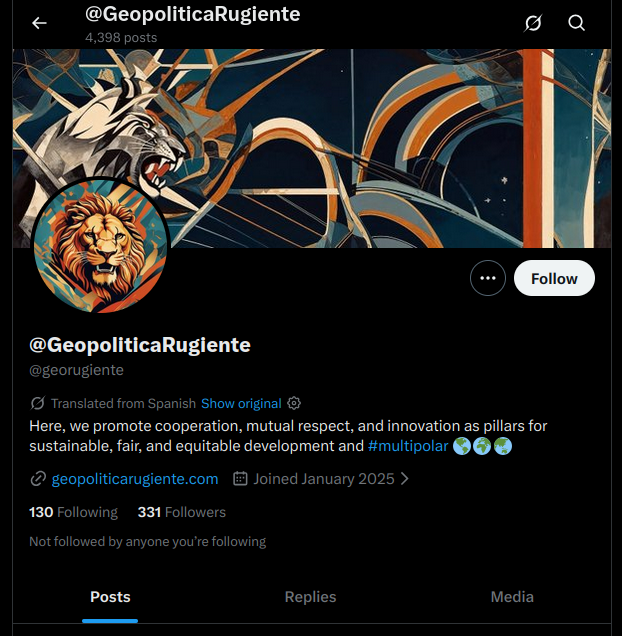
Investigations into the Doppelgänger campaign have documented several examples of this tactic. One operation targeting U.S. audiences involved approximately thirty-nine coordinated accounts posting replies within political discussions. Other investigations have identified larger botnet-style clusters consisting of more than one thousand coordinated accounts, indicating that the scale of these operations can vary significantly depending on the campaign objectives.
Within the overall influence architecture, the X layer therefore contributes algorithmic amplification rather than follower-based distribution. By inserting narratives into high-visibility discussion threads, the campaign can exploit platform algorithms that prioritize active conversations, allowing content posted by otherwise low-follower accounts to appear in front of large audiences. In this way, the X component of the campaign acts as a bridge between the controlled distribution channels of Telegram and the broader public information environment.
Narrative Propagation Mechanics
The spread of narratives within the Doppelgänger ecosystem follows a cascade-style propagation model in which content moves through a sequence of amplification stages. Each stage expands the potential audience and increases the likelihood that the narrative will enter broader online discourse. This cascading structure allows relatively small origin accounts or channels to generate large-scale exposure once the narrative reaches high-capacity distribution nodes.
The process typically begins with an origin post, which may appear either on a feeder website or within a smaller Telegram channel associated with the campaign ecosystem. At this stage, the narrative exists within a relatively limited audience environment and functions primarily as the initial seed for the distribution pipeline.

From there, the narrative is introduced into a Telegram origin channel, where it begins to circulate within networks of subscribers that regularly consume geopolitical or ideological content aligned with pro-Kremlin messaging. These origin channels often serve as staging points where narratives are prepared for broader amplification.
The critical expansion phase occurs when the narrative is reposted by a large Telegram amplifier channel with a substantial subscriber base. Channels operating at this level of the ecosystem can expose content to hundreds of thousands of users simultaneously. Once a narrative reaches this stage, it becomes highly visible across the Telegram information environment.
Following publication in a major amplifier channel, the narrative enters a secondary repost cascade. Smaller affiliated channels frequently repost content originating from large channels, either automatically or through loosely coordinated editorial behavior. This reposting activity produces a cascading effect in which the narrative spreads across interconnected Telegram communities, further expanding its reach.
After the narrative gains traction within Telegram, the campaign introduces the content into the X/Twitter layer through coordinated account activity. Clusters of disposable accounts begin posting links, excerpts, or commentary related to the narrative within active discussions on the platform. This step serves to insert the narrative into broader public conversations, particularly those involving political or geopolitical topics.
The final stage of the cascade occurs when the narrative achieves secondary discourse uptake. At this point, users outside the original campaign infrastructure begin referencing or discussing the narrative independently. The content may appear in comment threads, forums, blog posts, or other social media discussions, often without direct reference to the original source.
Through this cascade model, a narrative originating from a relatively small node within the campaign network can rapidly expand to reach a much larger audience. The combination of Telegram amplification and social media insertion enables the Doppelgänger ecosystem to convert limited initial publication into widespread exposure across multiple digital platforms.
Campaign Reach and Effects
Subscriber metrics from major Telegram amplification channels, combined with observed activity patterns, enable bounded estimates of reach for a typical Doppelgänger narrative wave. The distribution model using Telegram as the primary amplifier, followed by coordinated activity on X/Twitter means total exposure is driven by the number of participating channels and the intensity of downstream social amplification.
Operationally, narrative waves fall into three intensity tiers:
Baseline Campaign
The most common configuration. Narratives are pushed through multiple large Telegram channels, then reinforced by coordinated X/Twitter reply clusters. This layered amplification produces an estimated reach of 1.5–2.7 million users, with 100,000–300,000 interactions. Secondary uptake expands to 10,000–40,000 mentions, indicating spillover beyond controlled infrastructure into broader discourse.
Low-Intensity Campaign
A single major Telegram channel with limited X/Twitter support. The distribution cascade is constrained, yielding 800,000–1.3 million users reached, 40,000–120,000 interactions, and 2,000–5,000 secondary mentions. Despite lower scale, narratives still penetrate sizable audiences, particularly within high-interest topics.
High-Intensity Campaign
Aligned with major geopolitical events, leveraging elevated attention and search activity. Multiple high-capacity Telegram channels and dense X/Twitter coordination drive accelerated spread. Estimated reach increases to 3–5 million users, with 250,000–700,000 interactions and 40,000–100,000 secondary mentions. At this stage, narratives routinely escape campaign control and persist in wider information ecosystems.
Across all tiers, the architecture demonstrates consistent scaling behavior: small origin points are amplified through Telegram, reinforced via coordinated social activity, and ultimately propagated into broader public discourse.
Strategic Impact Assessment
The Doppelgänger campaign is engineered for visibility, not direct persuasion. Its architecture–feeder websites, Telegram amplification, and coordinated X/Twitter activity–prioritizes rapid distribution and repeated exposure across platforms to maximize encounter frequency.
The objective is to seed narratives into the information environment and sustain their circulation, rather than secure immediate belief. Repetition across multiple sources increases perceived relevance and can shape interpretation of events, even when claims remain contested.
A central mechanism is manufactured ubiquity. By injecting narratives into active discussions and amplifying them across channels, the campaign creates the appearance of widespread, organic debate. This perceived consensus elevates legitimacy, particularly when content surfaces simultaneously across domains and platforms.
Effectiveness does not require broad persuasion. Limited engagement is sufficient to generate secondary propagation mentions, reposts, and commentary that extend reach beyond controlled infrastructure. As these references accumulate, narratives diffuse into general discourse, producing a form of information contamination in which repeated exposure normalizes their presence.
Over time, this process increases perceived credibility and embeds narratives within the broader information ecosystem. The strategic outcome is not conversion, but contextual influence shaping how events are framed and understood.
Doctrinal Context: Doppelgänger Within Russian Information Confrontation Strategy
The operational architecture of the SDA / Doppelgänger campaign aligns closely with established Russian concepts of information confrontation (informatsionnoye protivoborstvo/информационное противоборство), a strategic doctrine that integrates information operations into broader geopolitical competition.
Rather than focusing solely on direct persuasion or propaganda in the traditional sense, Russian information confrontation doctrine emphasizes shaping the information environment itself. The objective is to influence how events are interpreted, weaken adversary cohesion, and introduce persistent uncertainty into public discourse.
The layered architecture observed in the Doppelgänger campaign, such as combined web infrastructure, social amplification networks, and rapid regeneration capabilities reflects this doctrinal emphasis on environmental influence rather than individual audience conversion.
Continuity With Soviet Active Measures
The operational structure of the Doppelgänger campaign demonstrates clear continuity with Soviet-era Active Measures, a category of covert influence operations historically conducted by the KGB and other Soviet intelligence services. Active Measures were designed to shape political perceptions abroad through the controlled dissemination of misleading or manipulated information. Rather than relying solely on overt propaganda channels, these operations frequently used covert or semi-covert mechanisms intended to obscure the origin of the messaging and create the appearance of independent sources.
Historically, Active Measures campaigns relied on a combination of forged publications, front organizations, and intermediary actors to introduce narratives into foreign information environments. Articles containing false or misleading claims were often placed in controlled outlets or sympathetic publications, where they could be cited by other media organizations without clear attribution to Soviet state actors. This layered dissemination model enabled narratives to circulate widely while masking their true origin in the same manner as the SDA/Doppelgänger campaigns do in the 21st century.

Several core techniques were characteristic of these operations. Soviet intelligence services frequently published fabricated or manipulated articles in outlets under their influence, ensuring that narratives appeared to originate from credible media sources. They also relied on intermediaries, sometimes sympathetic individuals or organizations, and sometimes unwitting participants to amplify and redistribute these narratives. Additionally, front organizations and proxy institutions were used to conceal the involvement of state actors, creating plausible deniability and complicating attribution.
The modern Doppelgänger ecosystem replicates many of these operational concepts but implements them through digital infrastructure rather than traditional print or broadcast channels. In place of forged newspapers or pamphlets, the campaign operates cloned media websites designed to resemble legitimate news organizations. Instead of proxy publications in foreign countries, the campaign relies on pseudo-journalistic domains that host narrative content while maintaining the appearance of independent media outlets.
Likewise, where Soviet Active Measures depended on diplomatic contacts, activist groups, or aligned publications to redistribute narratives, the Doppelgänger campaign utilizes Telegram amplification channels to perform a similar role. These channels function as distribution hubs that rapidly disseminate narratives to large subscriber bases. Finally, the rumor propagation networks historically used to circulate political claims have been replaced by coordinated X/Twitter reply swarms, which insert narratives into active discussions across social media platforms.
Although the underlying techniques remain conceptually similar, the digital environment dramatically increases the speed, scale, and reach of these operations. Where Cold War Active Measures might have taken weeks or months to propagate through traditional media channels, digital infrastructure allows narratives to circulate globally within hours. This acceleration enables modern influence campaigns such as Doppelgänger to achieve levels of audience exposure and message repetition that were difficult to achieve through earlier forms of covert propaganda.
Alignment With Contemporary Russian Hybrid Warfare Doctrine
The operational design of the Doppelgänger campaign also reflects principles associated with Russia’s contemporary hybrid warfare doctrine, which integrates informational influence with broader geopolitical strategy. Discussions of this doctrine frequently reference writings and strategic concepts attributed to Russian military leadership that emphasize the growing importance of non-military tools in modern conflict.
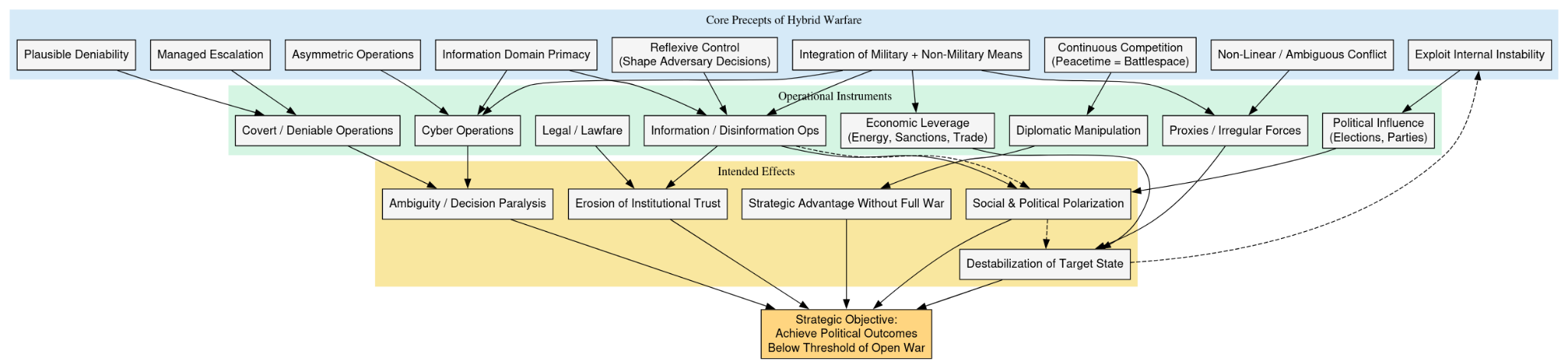
Hybrid warfare is characterized by the coordinated use of military, political, economic, and informational instruments to influence adversaries while avoiding direct conventional confrontation. Within this framework, influence operations play a central role in shaping public perception, undermining adversary cohesion, and influencing decision-making environments before or during geopolitical crises.
Information operations such as the Doppelgänger campaign function as one component of this broader strategic toolkit. By introducing and amplifying narratives across digital information environments, the campaign can affect political discourse and public perception in ways that complement diplomatic, economic, or military pressure. The architecture of the campaign–combining narrative development, infrastructure hosting, and multi-platform distribution–demonstrates how modern influence capabilities can operate continuously alongside other forms of geopolitical competition.
Within the context of hybrid warfare strategy, campaigns like Doppelgänger serve several strategic purposes. They can weaken public support for adversary policies, particularly in democratic societies where political legitimacy depends on public opinion. By amplifying internal political disagreements or contentious social issues, such operations may also intensify existing divisions within target societies, complicating unified responses to international crises.
Influence campaigns can also contribute to strategic ambiguity surrounding geopolitical events. By introducing multiple competing explanations or allegations into public discourse, the information environment becomes more difficult to interpret, increasing uncertainty about the causes or implications of major developments. In addition, these campaigns can help shape international narratives around conflicts, promoting interpretations that align with Russian strategic messaging while challenging competing perspectives.
The Doppelgänger campaign’s operational emphasis on narrative saturation rather than direct persuasion aligns closely with this doctrinal approach. Rather than focusing on convincing audiences of a single specific claim, the campaign introduces a large volume of narratives designed to circulate simultaneously across the information ecosystem. This proliferation of competing narratives can complicate consensus formation, increase confusion about the reliability of information sources, and ultimately influence how audiences interpret geopolitical events.
Information Environment Manipulation
Russian information confrontation doctrine prioritizes control of the interpretive context through which audiences understand events. Perception is shaped less by facts than by narrative frameworks that assign meaning, causality, and emotional weight. By manipulating these frameworks, influence operations can alter how events are interpreted without changing the underlying facts.
Accordingly, campaigns focus on reshaping context rather than advancing isolated claims. This is achieved by promoting alternative explanations, introducing conspiratorial interpretations, and amplifying emotionally charged narratives to influence perception and legitimacy.
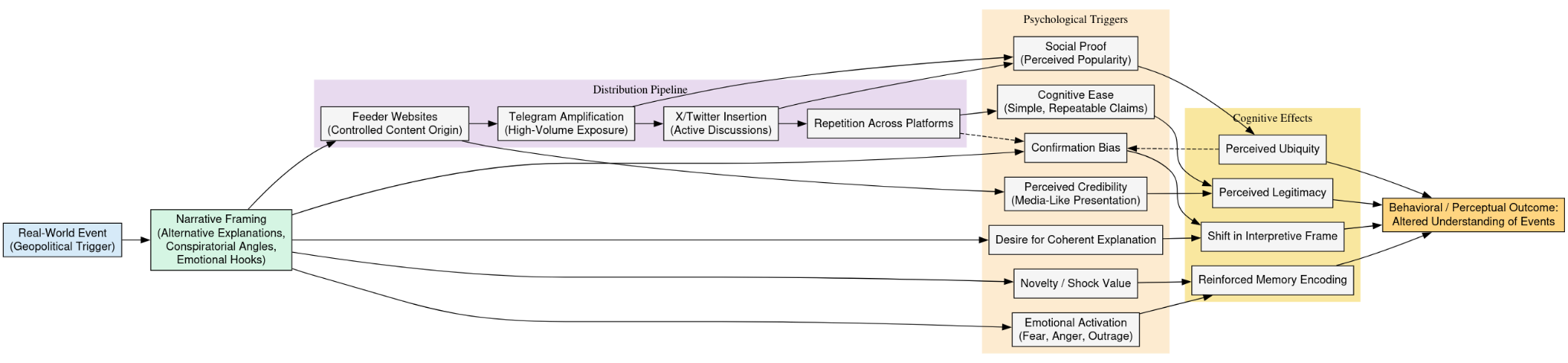
The Doppelgänger campaign operationalizes this model through a repeatable distribution pipeline. Narratives are developed in alignment with strategic objectives, published on feeder websites designed to mimic legitimate media, amplified via Telegram channels, and then inserted into active discussions on X/Twitter. This sequence enables rapid, multi-platform injection of interpretive frames into public discourse.
The architecture is modular and resilient, allowing narratives to be redeployed across domains, channels, and account clusters even after disruption. This persistence sustains exposure over time, reinforcing narrative frames and embedding them within the broader information environment.
Strategic Persistence
A defining characteristic of Russian information confrontation strategy is operational persistence. Rather than relying on isolated or short-lived influence campaigns, Russian information operations are typically conducted as continuous activities designed to exert sustained pressure on the information environments of targeted societies. This approach recognizes that influence within complex media ecosystems is cumulative; narratives may gain traction gradually through repeated exposure rather than through a single high-impact campaign.
Within this framework, influence operations are structured to remain active over extended periods, allowing operators to continually introduce, reinforce, and adapt narratives in response to changing geopolitical conditions. The objective is not simply to deliver a single message but to maintain a persistent presence within public discourse, ensuring that strategically aligned narratives remain visible and repeatedly encountered by audiences.
The Doppelgänger ecosystem reflects this emphasis on persistence through several operational mechanisms embedded within its infrastructure and distribution architecture. One such mechanism is rapid domain regeneration, which allows operators to replace disrupted or seized feeder websites quickly. When a domain is taken offline, replacement sites can be deployed within a short time frame, allowing the narrative distribution pipeline to continue functioning with minimal interruption.
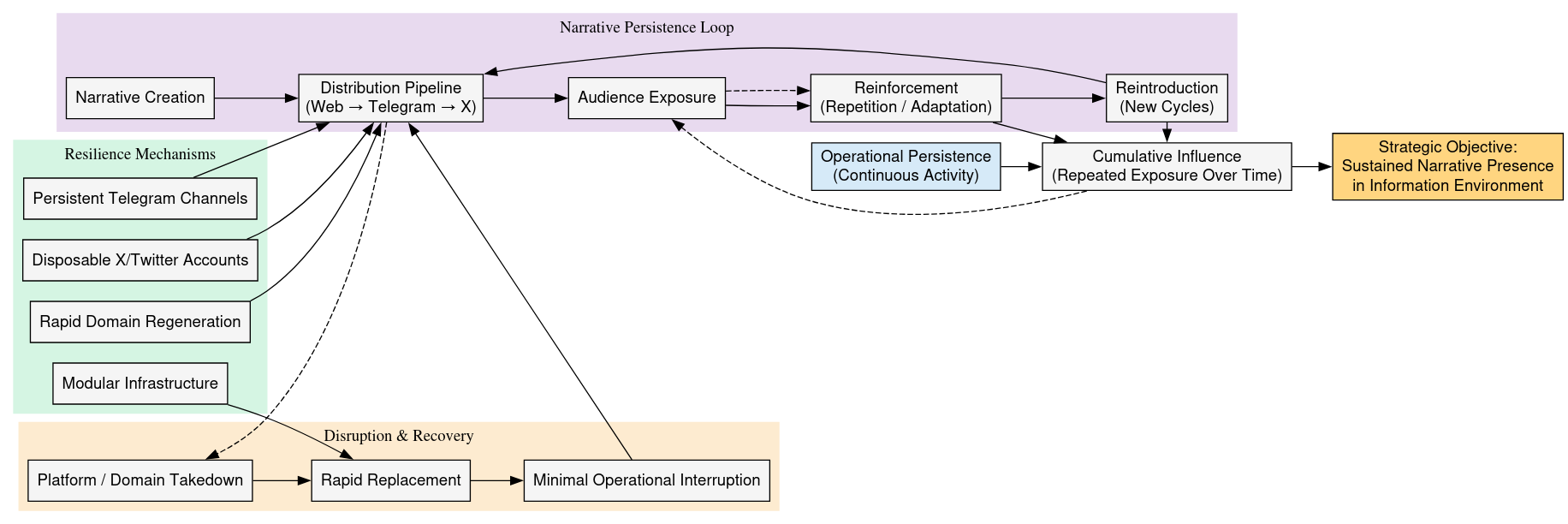
The campaign also relies heavily on disposable social media accounts, particularly on platforms such as X/Twitter. These accounts are typically created with minimal investment in long-term identity or follower growth, allowing them to be used for short operational cycles and replaced easily if they are suspended or detected. This disposable-account model reduces the impact of platform enforcement actions and enables the campaign to maintain continuous activity despite account removals.
Another key element of this persistence is the campaign’s integration with existing Telegram channels that already possess large subscriber bases. Because these channels operate as stable distribution hubs within the broader pro-Kremlin information ecosystem, they provide a consistent amplification platform that does not need to be rebuilt for each campaign wave. This existing infrastructure allows narratives to be circulated repeatedly through established audiences.
Finally, the campaign reinforces persistence through the repeated reintroduction of narratives across multiple operational cycles. Even after a particular narrative has circulated through the distribution pipeline, the same or slightly modified messaging may be reintroduced in later campaign waves, often in response to new geopolitical developments. This repetition increases the likelihood that the narrative will become embedded within broader online discourse.
Taken together, these mechanisms allow the Doppelgänger campaign to maintain long-term influence activity even when individual components of the infrastructure are disrupted. The persistence of the system ensures that the broader narrative themes promoted by the campaign remain present within the information environment, enabling influence operations to continue shaping discourse over time.
Strategic Implications
The Doppelgänger campaign represents a mature influence capability that fuses traditional propaganda methods with modern digital infrastructure. It operates as a coordinated ecosystem, producing, distributing, and reinforcing narratives across platforms, rather than as isolated disinformation activity.
This model aligns with state-level information confrontation, where influence operations are integrated into broader geopolitical strategy. Its architecture functions as a persistent mechanism for shaping external information environments.
These components form a scalable, resilient distribution system. Modular design enables rapid adaptation, infrastructure regeneration, and repeated campaign cycles despite disruption.
Effectiveness is not defined by direct persuasion, but by cumulative environmental impact. Through sustained narrative injection and amplification of controversy, the campaign degrades informational coherence, proliferates competing interpretations, and complicates consensus formation.
Detection Framework Development
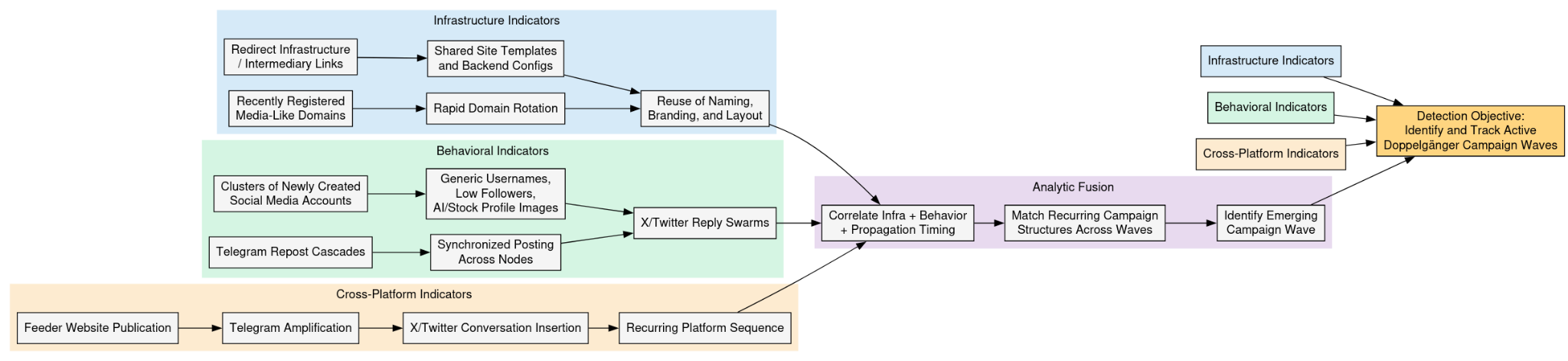
The operational characteristics of the Doppelgänger campaign produce a number of recurring technical and behavioral indicators that can assist analysts in identifying active influence operations. Although individual domains, social media accounts, and distribution channels may change over time, the underlying structure of the campaign’s infrastructure and propagation mechanisms generates patterns that are observable across multiple campaign waves.
These indicators generally fall into three broad categories: infrastructure indicators, behavioral indicators, and cross-platform propagation indicators. Together, they provide a framework for identifying and tracking influence activity associated with the Doppelgänger ecosystem.
Infrastructure Indicators
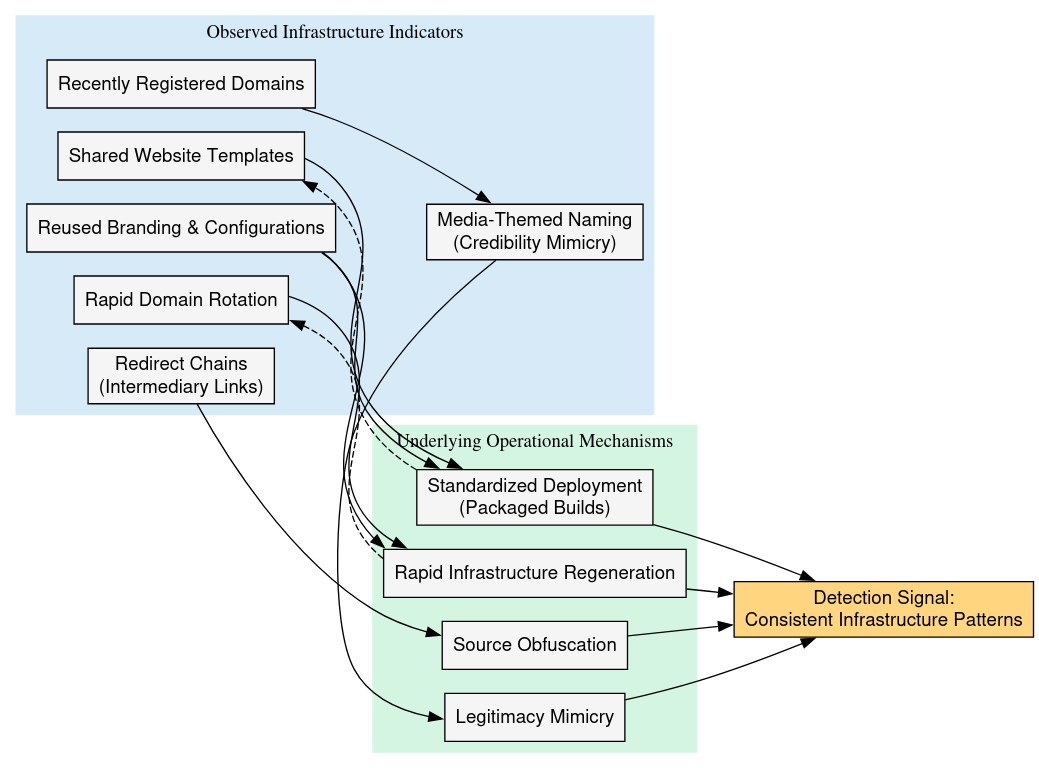
Infrastructure indicators are the most consistent signals of the campaign. The feeder network relies on recently registered domains that mimic legitimate news or commentary sites, using media-style naming to project credibility.
A key pattern is rapid domain rotation: sites are replaced quickly after disruption, often reusing similar naming conventions, branding, and technical configurations. Redirect infrastructure is also common, routing users through intermediary links to obscure source relationships while enabling traffic tracking.
Repeated website templates further indicate standardization. Shared layouts, visual elements, and backend configurations suggest the use of prebuilt deployment packages that support rapid infrastructure regeneration.
Behavioral Indicators
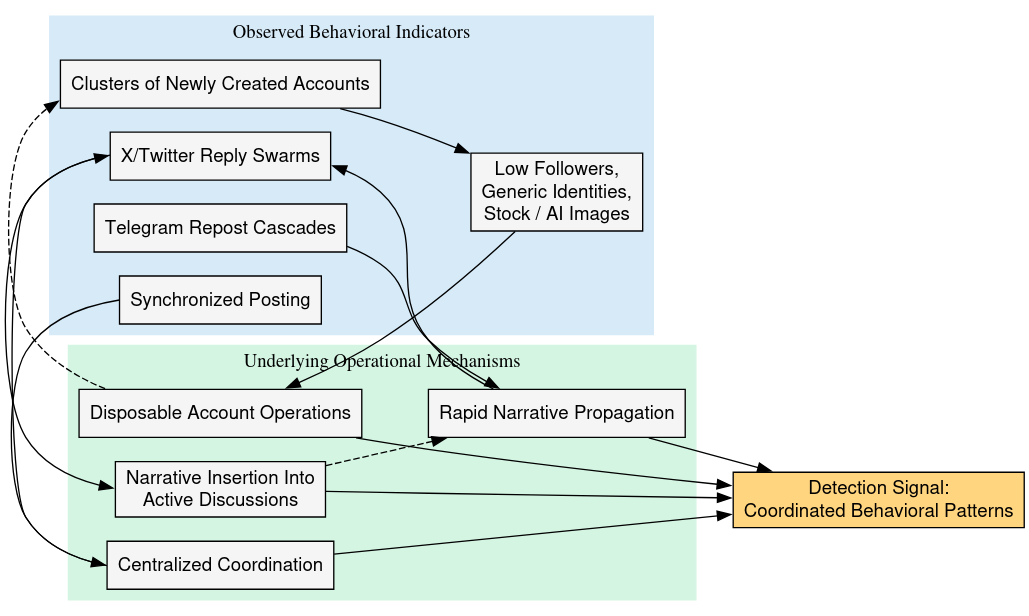
Beyond infrastructure, the campaign exhibits clear behavioral indicators of coordination. Telegram repost cascades are the most visible signal, where identical narratives propagate rapidly across multiple channels from a small set of origin posts.
Synchronized posting is also common, with near-identical content appearing across channels and accounts within minutes, indicating centralized dissemination. Clusters of newly created social media accounts characterized by low followers, generic identities, and stock or AI-generated images support short, disposable operational cycles.
On X/Twitter, activity often takes the form of reply swarms, where coordinated accounts inject narrative fragments and links into active discussions to amplify visibility and reach.
Cross-Platform Indicators
A third category of indicators involves the cross-platform propagation patterns that characterize the campaign’s distribution pipeline. Narratives often follow a consistent sequence of appearance across platforms, beginning with publication on a feeder website and subsequently spreading through Telegram amplification channels.
Shortly after appearing on Telegram, the same narratives may be introduced into X/Twitter discussions through coordinated account activity. This sequence—feeder site publication followed by Telegram amplification and social media insertion—represents a recurring propagation pattern that can signal the presence of a coordinated influence operation.
By monitoring these infrastructure, behavioral, and cross-platform indicators together, analysts can identify emerging campaign waves and better understand the mechanisms through which the Doppelgänger ecosystem distributes narratives across the digital information environment.
Disruption Strategy
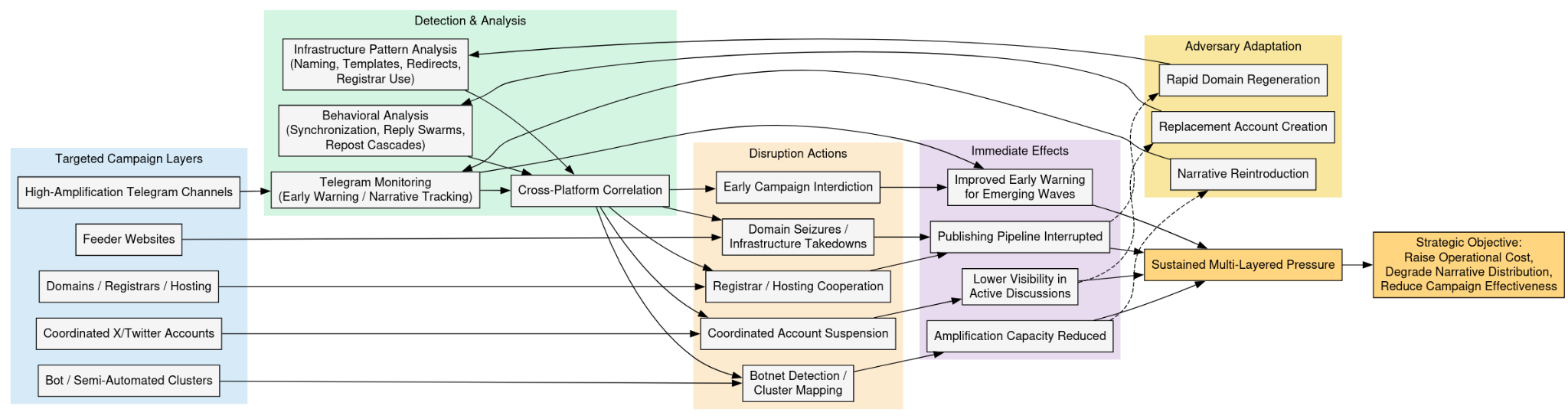
Disrupting the Doppelgänger ecosystem requires a multi-layered approach targeting both infrastructure and distribution channels. Its design of rapidly replaceable domains, disposable accounts, and persistent amplification hubs means mitigation must be continuous and coordinated, not episodic.
Domain seizures and infrastructure takedowns can interrupt the publishing pipeline, but must be repeated due to rapid regeneration. Collaboration with registrars and hosting providers, using identifiable patterns in domain naming and deployment, can slow replacement cycles.
Account removal is equally critical. Suspending coordinated clusters on platforms like X/Twitter reduces narrative insertion into high-visibility discussions, while botnet detection helps identify and disrupt amplification networks exhibiting synchronized behavior.
Monitoring Telegram channels provides early warning and visibility into narrative propagation, even when direct removal is constrained.
Because campaign assets are disposable by design, effective disruption depends on sustained, cross-platform pressure. This raises operational costs, degrades distribution efficiency, and incrementally reduces overall campaign impact.
Potential Operational Pivots During Major Geopolitical Crisis
The Doppelgänger architecture is highly adaptable and can be rapidly repurposed for influence operations during major geopolitical crises, including the U.S.–Iran conflict. By integrating narrative development, controlled web infrastructure, and multi-platform distribution, it provides a ready mechanism for injecting crisis narratives into Western information environments.
In such scenarios, the system would likely be used to frame events in real time. Feeder sites could publish alternative interpretations of incidents emphasizing escalation, civilian harm, or legal violations while Telegram and X/Twitter amplification insert these narratives into early-stage public discourse.
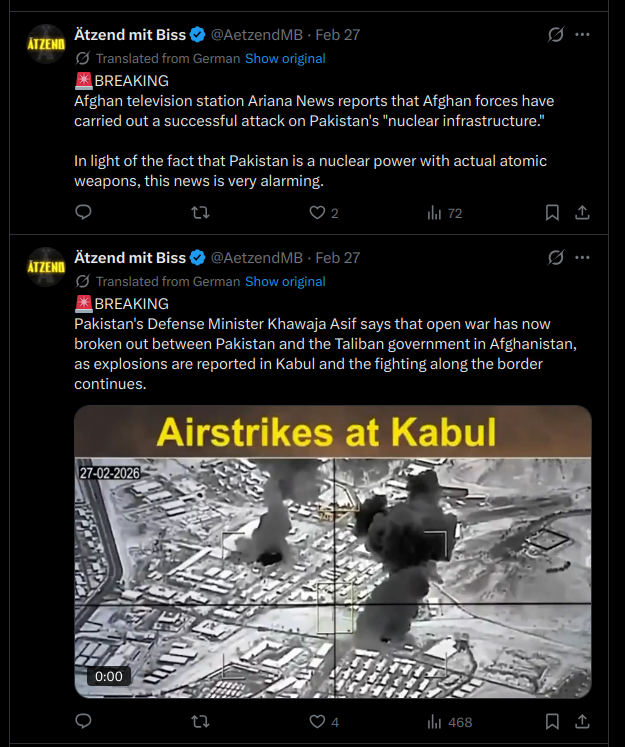
It can also be used to exacerbate domestic divisions, promoting skepticism about intervention, highlighting economic costs, or questioning strategic legitimacy. Concurrently, the system can introduce multiple, conflicting explanations for key events, generating uncertainty and complicating verification.
The infrastructure supports targeted messaging, enabling narratives tailored to specific audiences, such as economic risk for European audiences, and political or military costs for U.S. audiences across languages and regions. It also facilitates information laundering, where content from pseudo-journalistic sites is recirculated and cited beyond the originating network.
Overall, Doppelgänger functions as a rapid-deployment influence platform. In crisis conditions, it can shape initial interpretations, amplify divisions, and establish persistent narrative frames that influence how conflicts are understood.
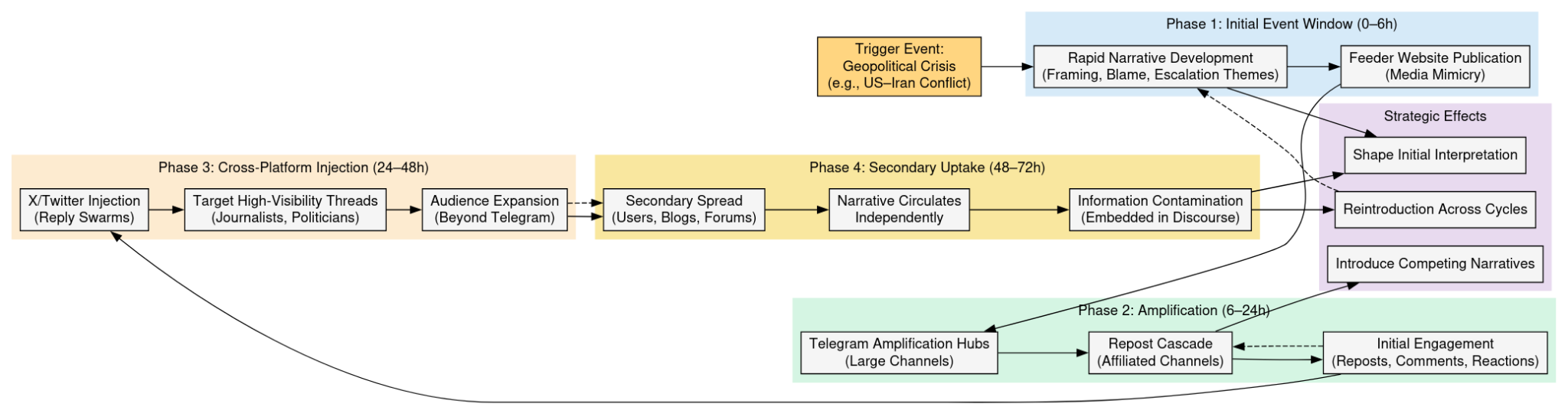
Example Crisis Influence Timeline: Narrative Propagation During the First 72 Hours
In a major geopolitical crisis such as the recent military confrontation between the United States and Iran the Doppelgänger influence infrastructure could be rapidly activated to shape early interpretations of events. Because the campaign’s architecture integrates narrative development, feeder website infrastructure, Telegram amplification networks, and coordinated social media activity, it is capable of introducing narratives into the information environment within hours of a triggering event.
The following model outlines how a typical influence operation using the Doppelgänger ecosystem could unfold during the first seventy-two hours following a major geopolitical incident. While the precise timing and scale of each phase may vary depending on operational objectives, documented campaign behavior suggests that the propagation pipeline follows a predictable sequence.
Initial Event Window (0–6 Hours)
The first phase begins immediately after a major geopolitical event becomes public knowledge. During this period, information environments are highly volatile and public understanding of the event is still forming. This stage provides an opportunity for influence operations to introduce interpretive narratives before authoritative reporting stabilizes the factual narrative.
During this window, campaign operators can rapidly produce narrative content aligned with strategic messaging objectives. These narratives may frame the event as evidence of escalation, highlight alleged civilian impacts, question the legitimacy of military actions, or introduce competing explanations regarding responsibility for the event.
Once developed, the narrative is published on one or more feeder websites within the Doppelgänger infrastructure. These articles typically mimic the appearance of legitimate news reporting, enabling them to be shared in social media discussions without immediately revealing their origin within a coordinated campaign.
Amplification Phase (6–24 Hours)
Following initial publication, the narrative enters the Telegram amplification layer, where links to the feeder websites are reposted across established pro-Kremlin Telegram channels. Because many of these channels maintain large subscriber bases and distribute content without algorithmic filtering, this stage can expose the narrative to hundreds of thousands of users within a short period of time.
Large Telegram channels function as distribution hubs that initiate the amplification cascade. Once the narrative appears in one or more of these channels, smaller affiliated channels frequently repost the content, expanding its reach across interconnected communities. This cascade effect can rapidly increase the narrative’s visibility across the Telegram information ecosystem.
At this stage, the narrative begins generating engagement in the form of reposts, comments, and reactions, creating the appearance of active discussion around the topic.
Cross-Platform Injection Phase (24–48 Hours)
Once the narrative has gained traction within Telegram networks, the campaign typically proceeds to cross-platform injection, introducing the content into broader public discussions on platforms such as X/Twitter. Clusters of disposable accounts begin posting links, excerpts, or commentary related to the narrative within active political conversations.
Rather than broadcasting content to followers, these accounts frequently target high-visibility discussion threads, including posts by journalists, politicians, or commentators addressing the crisis. By inserting replies into these conversations, the campaign attempts to expose the narrative to audiences that are not directly connected to the Telegram ecosystem.
This stage significantly expands the potential audience and increases the likelihood that the narrative will be encountered by individuals participating in broader geopolitical discussions.
Secondary Uptake Phase (48–72 Hours)
During the final stage of the initial propagation cycle, the narrative may begin to achieve secondary uptake outside the campaign’s direct infrastructure. Users who encounter the narrative through social media discussions may reference or repeat the claims in additional posts, blogs, forums, or commentary threads.
At this point, the narrative can circulate independently of the original campaign infrastructure. Because the narrative now appears across multiple platforms and sources, it may begin to influence how audiences interpret the underlying geopolitical event.
Even when the narrative itself remains contested, the presence of repeated references and discussions can contribute to information contamination, where the narrative becomes embedded within the broader discourse surrounding the event.
Strategic Implication
This seventy-two-hour propagation model illustrates how the Doppelgänger infrastructure can function as a rapid-deployment influence platform during geopolitical crises. By introducing narratives early in the information cycle and amplifying them across multiple platforms, the campaign can shape initial interpretations of events and inject competing narratives into public discourse before authoritative accounts become widely established.
Because the campaign’s infrastructure is modular and persistent, the same narratives can also be reintroduced in subsequent cycles as new developments occur, allowing influence operations to remain active throughout the duration of a geopolitical crisis.
Analytical Judgment
The Doppelgänger campaign is a resilient, scalable influence system built for sustained, multi-platform operations. It integrates narrative development, controlled web infrastructure, and coordinated social amplification to repeatedly inject and reinforce strategic messaging.
Its durability derives from a modular design that separates creation, hosting, and distribution, enabling rapid replacement of disrupted domains and accounts with minimal impact on operations. Cross-platform amplification extends reach: feeder sites provide controlled publication, Telegram delivers high-volume exposure, and coordinated X/Twitter activity inserts narratives into broader discourse.
Rapid regeneration further reinforces persistence, allowing infrastructure and accounts to be reconstituted quickly after takedowns. Within this model, Telegram functions as the primary reach engine, while X/Twitter enables penetration into high-visibility Western discussions.
Overall, Doppelgänger exemplifies a modern influence architecture that combines traditional propaganda logic with flexible digital infrastructure, sustaining narrative presence despite continuous disruption.
Technical Appendix A: Full Infrastructure Map of the SDA / Structura Ecosystem